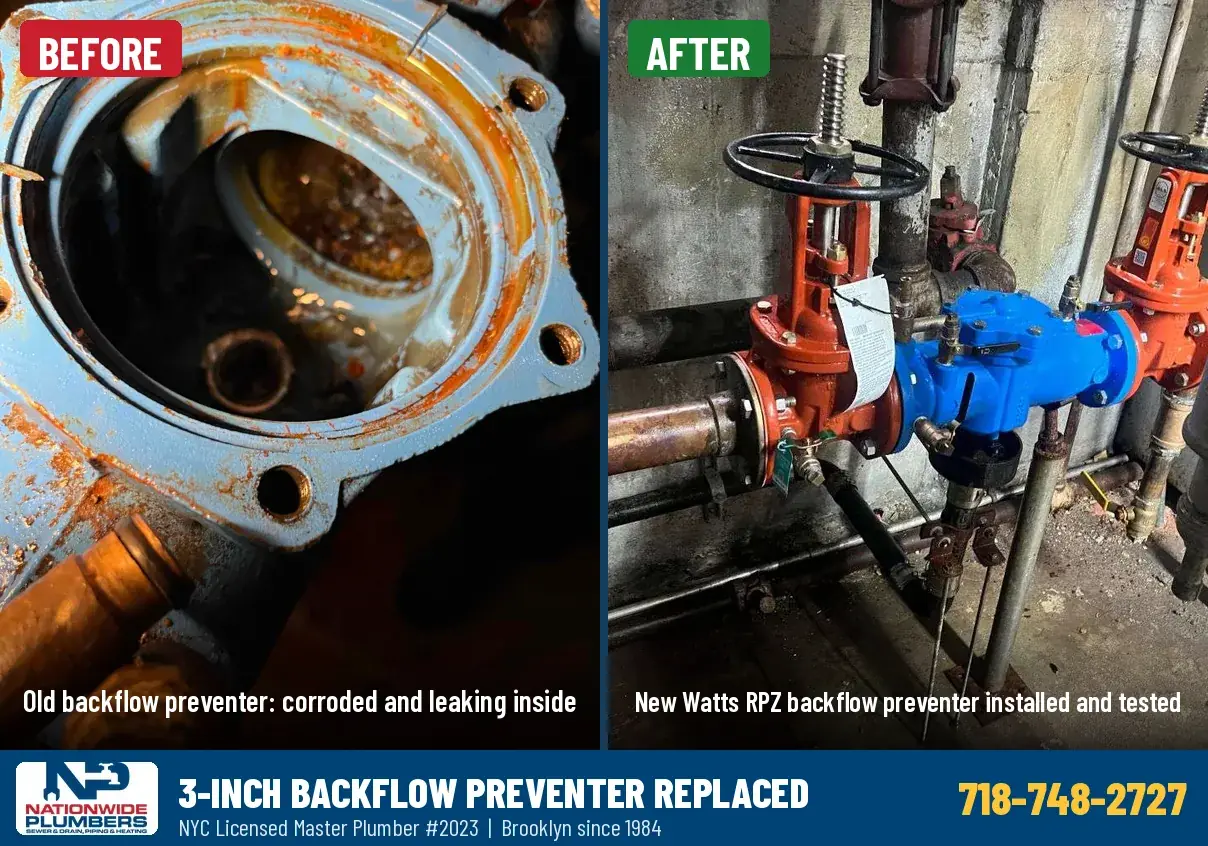
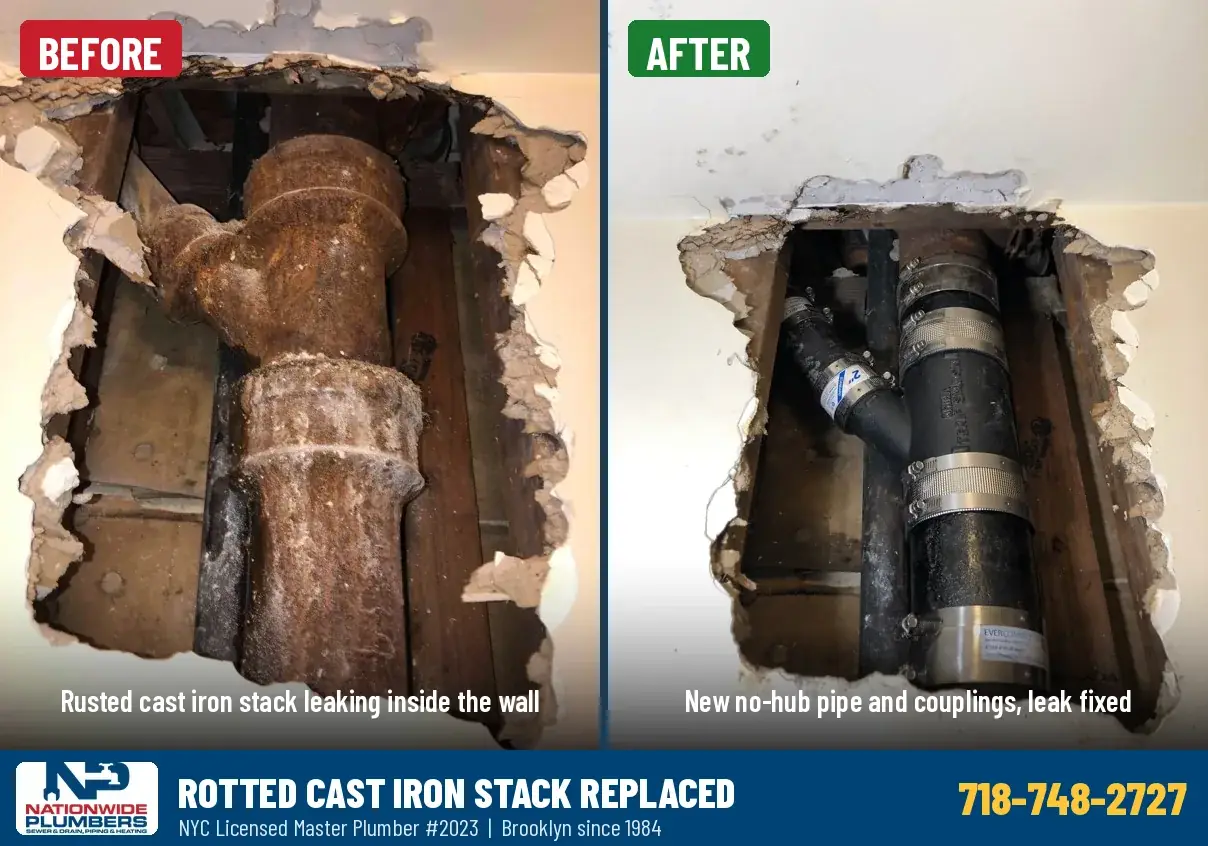
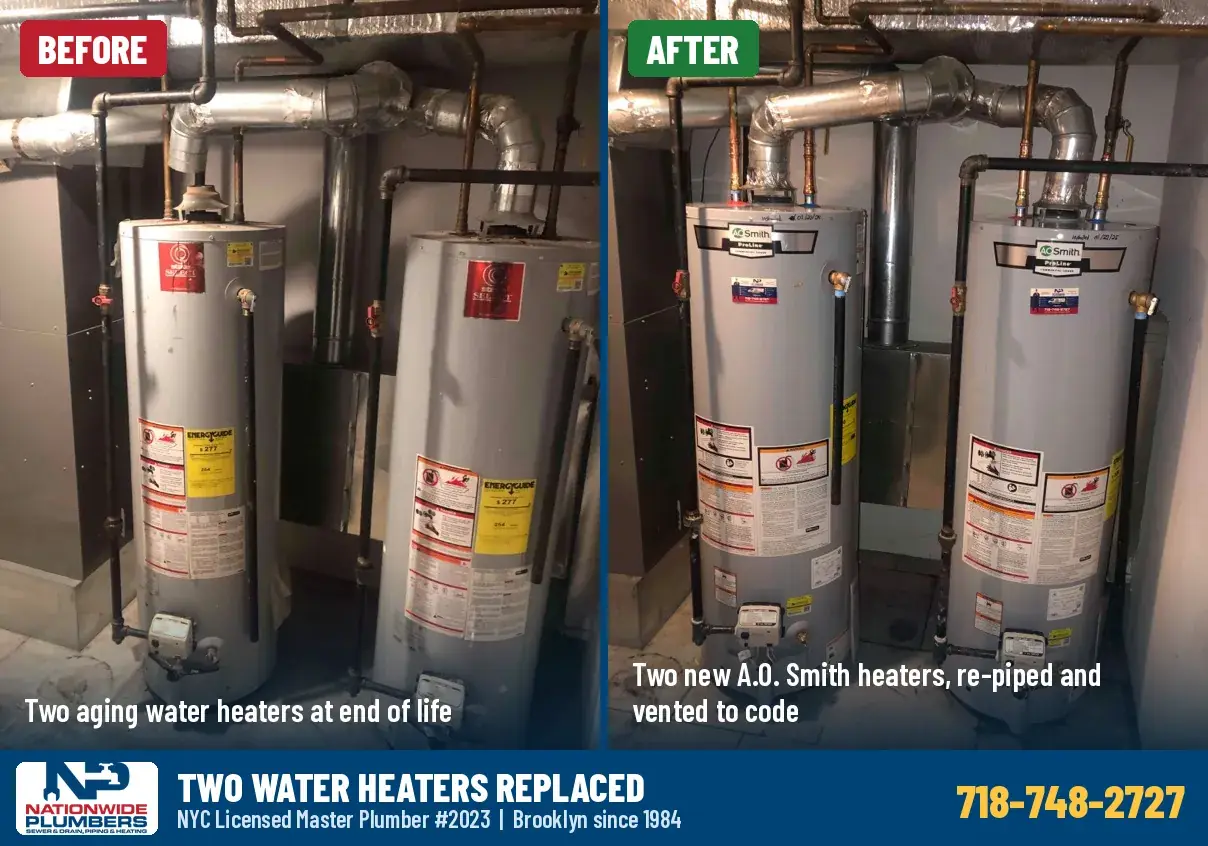
Every backflow prevention device in a New York City building must be tested at least once a year by a New York State certified tester, and the passing report must be filed with NYC DEP. Installing or replacing a device is a filed job done by a licensed master plumber. Nationwide Plumbers handles testing, repair, replacement and the paperwork.
Key requirements
- Annual testing is mandatory. NYC DEP's Cross Connection Control Program requires every installed backflow preventer to be tested annually by a tester certified by the New York State Department of Health. A plumber's license alone does not qualify someone to test the device.
- The clock runs off the device, not the calendar. The deadline is the anniversary of the last passing test, not December 31. Buildings with several devices often have several different due dates.
- The report has to be filed, not just performed. A test that was done but never submitted to DEP looks identical to a test that never happened. Filing is part of the job.
- Installing or replacing a device is a filed job. Backflow preventer plans must be approved by DEP and the installation performed by a NYC-licensed master plumber, it is not a parts swap.
- Typical triggers in NYC buildings: fire sprinkler systems, boilers with chemical treatment, cooling towers, commercial kitchens, laundromats, car washes, medical and dental offices, irrigation systems, and buildings with booster pumps or house tanks.
What a backflow preventer actually does, and why DEP cares
The city's water mains are pressurized in one direction. When that pressure drops, a main break, a hydrant opened for a fire, a pump cycling in a tall building, water inside a building can reverse direction and get pulled back into the public supply. If that water has passed through a boiler treated with chemicals, a cooling tower on a Long Island City rooftop, a commercial dish line in Flushing, or an irrigation head sitting in a lawn, the contamination goes into the main, not just the building.
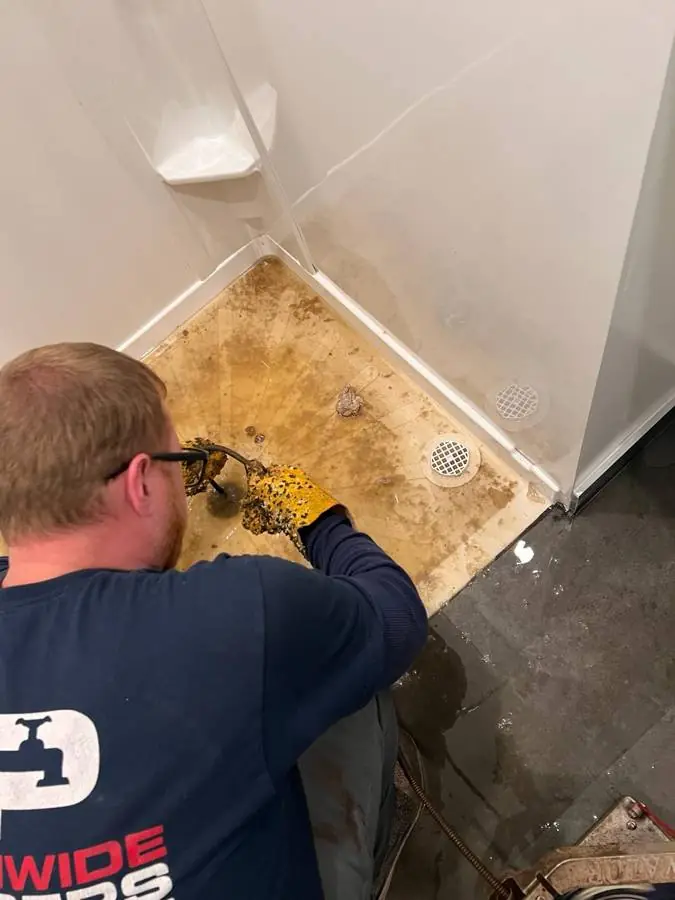
A backflow preventer is the mechanical barrier against that. Two types matter in practice:
- RPZ (reduced pressure zone assembly), required for high-hazard connections. It has a relief port that dumps to the floor when the internal checks fail, which is why RPZ installations need a drain and a receptor sized to take a full discharge.
- DCVA (double check valve assembly), permitted for lower-hazard connections, commonly fire lines without chemical additives.
Both are mechanical assemblies with rubber seats and springs. They wear. That is the entire reason the testing requirement exists annually rather than once at installation.
The legal framework
Three layers stack here, and Queens owners regularly discover them in the wrong order:
- New York State Sanitary Code (10 NYCRR Part 5) establishes cross-connection control and the annual testing requirement statewide, along with the state certification for testers.
- NYC DEP's Cross Connection Control Program administers it locally, plan approval, device registration, and receipt of the annual test reports. DEP publishes the current filing method and forms; confirm the current submission portal with DEP before your due date, since the intake process has changed more than once in recent years.
- The NYC Plumbing Code governs the installation itself, including where the device may sit, required clearances for testing, and the relief discharge and air gap for RPZ units.
Enforcement is real. A missed test typically produces a DEP notice, and unresolved violations can escalate to an OATH/ECB proceeding with penalties. The more common practical damage in Queens, though, is transactional: a lapsed backflow certificate turns up during a refinance, a co-op sublet review, a DOB sign-off, or a Department of Health restaurant inspection, and stalls it.
What this looks like in Queens specifically
Queens is not one building stock, and the backflow exposure differs sharply by neighborhood.
Long Island City and Hunters Point. The newest and densest inventory in the borough, high-rise residential with amenity pools, rooftop cooling towers, garage floor drains, and booster-pump systems. These buildings frequently have three or more registered devices with staggered test dates, and a single missed report on a cooling tower line is enough to put the property out of compliance.
Flushing and Downtown Flushing. Heavy mixed-use: ground-floor restaurants and food processing under residential floors. Commercial kitchens, grease-handling, and shared service lines create high-hazard connections that require RPZ protection, and the tenant turnover rate means new connections get added without anyone updating the device registry.
Astoria, Sunnyside, and Woodside. Pre-war and post-war walk-ups and six-story elevator buildings, many with original boilers that have since been fitted with chemical feed systems. Adding treatment to a heating loop creates a hazard that the building's original plumbing never anticipated.
Forest Hills, Rego Park, and Kew Gardens. Large pre-war co-ops with house tanks, booster pumps, and, on the garden-apartment complexes, irrigation systems. Irrigation is the single most commonly forgotten device class in the borough, because nobody thinks of a sprinkler head as a plumbing fixture.
Maspeth, Ridgewood, Middle Village, and College Point. Light industrial and commercial garages, car washes, and food manufacturing. These are the highest-hazard connections in Queens and draw the most consistent DEP attention.
Jamaica, Jackson Heights, Elmhurst, Corona, Bayside, Whitestone, Ozone Park, Howard Beach, and the Rockaways all carry the same mix in smaller proportions, the trigger is the use, not the ZIP code.
How to get compliant if you're behind
- Inventory your devices. Walk the service entry, the fire riser room, the boiler room, the roof, and any irrigation manifold. Record make, model, size, and serial number for each.
- Pull your filing history from DEP to see which devices are registered and what the last recorded test date was for each. Unregistered devices are a separate problem from untested ones.
- Schedule a certified test on the lapsed devices. Expect some to fail, a device that has gone two or three years without a test frequently needs a rebuild.
- Confirm the report was filed, and keep a copy in the building's compliance file. Ask your plumber for the filing confirmation, not just the test form.
- Put the anniversary dates on a calendar with a 60-day lead. This is the entire ongoing obligation.
Backflow Preventer Testing in NYC: FAQ
How often does a backflow preventer have to be tested in NYC?
At least once every twelve months, by a New York State–certified backflow prevention device tester, with the results filed with NYC DEP. The due date runs from the last passing test, not from the start of the calendar year.
Who is allowed to test a backflow preventer in Queens?
Only a tester holding current New York State Department of Health backflow prevention device tester certification, using calibrated test equipment. A NYC master plumber license is required for installation and repair work, but testing requires the separate state certification.
Does my Queens building even need a backflow preventer?
If it has a fire sprinkler system, a chemically treated boiler, a cooling tower, a commercial kitchen, a laundry, an irrigation system, a booster pump, or a medical or industrial use, almost certainly yes. Many older Queens buildings have a device installed years ago that nobody currently on site knows about, start by looking at the service entry.
What happens if I miss the annual test?
You are out of compliance immediately. DEP can issue a violation, penalties can follow through OATH/ECB, and in a high-hazard case DEP has the authority to require the connection be addressed. More routinely, the lapse blocks a sale, refinance, DOB sign-off, or health inspection until it is cured.
My device failed the test. What now?
Most failures are repairable, worn check seats, a fouled relief valve, a failed spring. A rebuild kit and retest is the normal path. Full replacement is usually only required when the assembly is obsolete, undersized for the current hazard classification, or physically inaccessible for testing.
Can I test my own device if I own the building?
No. The certification is held by an individual tester and is not transferable to an owner or a building superintendent, regardless of how long they have run the system.